Showing posts with label History. Show all posts
Showing posts with label History. Show all posts
Tuesday, 11 March 2014
This is a relatively brief book that looks at the causes of The First
World War. It does not contain any new research and there is not much
that is new in it.

The author's thesis is broadly that all of the world powers were preparing for war from the 1900s onwards. The military leaders of all the great powers were building plans for war, and that this lead to an environment in which was inevitable. Meanwhile many working class people were effected by nationalist, patriotism and social Darwinism which acted to encourage the belief that foreigners were an "other" to be feared or defeated.
The principle thesis is that leaders allowed the war to happen, or at least were too weak to stop it. There was little communication at the top and no attempt to defuse the situation, and the author argues this means that the leaders were guilty by omission of starting the war.
A key problem for me is this book feels to much like an essay rather than a book. It is very brief and contains little real insight. It is a nice primer, but I felt a bit disappointed. As we approach the 100 year anniversary there is going to be a lot of information around this period. Two key questions are whether the war was justified and who bears the blame for starting the war. The author clearly argues the leaders of all the Great Powers were responsible. But I don't think there is enough evidence presented to convince me.
I personally preferred The Pity of War by Niall Ferguson, which argues that Britain bears much of the responsibility for war The Forgotten Victory by Gary Sheffield which lays the blame with German militarism. These books just feel more meaty to me.

The author's thesis is broadly that all of the world powers were preparing for war from the 1900s onwards. The military leaders of all the great powers were building plans for war, and that this lead to an environment in which was inevitable. Meanwhile many working class people were effected by nationalist, patriotism and social Darwinism which acted to encourage the belief that foreigners were an "other" to be feared or defeated.
The principle thesis is that leaders allowed the war to happen, or at least were too weak to stop it. There was little communication at the top and no attempt to defuse the situation, and the author argues this means that the leaders were guilty by omission of starting the war.
A key problem for me is this book feels to much like an essay rather than a book. It is very brief and contains little real insight. It is a nice primer, but I felt a bit disappointed. As we approach the 100 year anniversary there is going to be a lot of information around this period. Two key questions are whether the war was justified and who bears the blame for starting the war. The author clearly argues the leaders of all the Great Powers were responsible. But I don't think there is enough evidence presented to convince me.
I personally preferred The Pity of War by Niall Ferguson, which argues that Britain bears much of the responsibility for war The Forgotten Victory by Gary Sheffield which lays the blame with German militarism. These books just feel more meaty to me.

Sunday, 9 February 2014
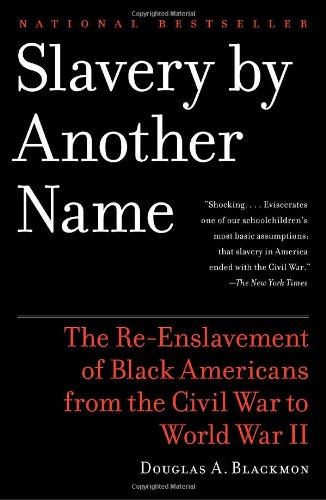
It was not an area I knew much about, and I assumed the end of the civil war marked the end of slavery. This book highlights that far from being an end to slavery the institutions of the Deep South merely changed to allow a white elite to continue their exploitation of blacks. The principle way this was done was to allow states to implement forced labour as a punishment for various crimes. The crimes were minor; vagrancy, etc and the punishments disproportionately were aimed at blacks.
The victis of these crimes were tried in kangeroo courts without much just of getting a fair trial. Once sentenced they were either forced to pay a fine or be submitted to forced labour. Once this had happened they were then rented out to private companies and individuals. If they tried to escape or got sick the cost of dealing with this was added to their term. The slave owners transformed into people who leased slaves from the state. However as the economy moved from cotton picking to mining the conditions actually grew worse over time. There was little to stop the workers being poorly treated.
The system also offered financial incentives to those who arrested blacks or tried them. The result was the legal system acted as a corrupt way of recruiting labour.
In addition there were various "Jim Crow" laws which segregated education and leisure, as well as disinfranchising black voters. These were became more onerous over time, to prevent black people from gaining political power.
This book analyses some of the failures of whites to address the issues of continued slavery. The Federal government was too weak and was unwilling to get involved in the issue. This was due in part to an unwillingness to get involved in states affairs, but also residual racism among the political classes.
The Civil Rights movement is not covered in this book, the book seems to concentrate mostly on the first generation after the Civil War(ie mostly before and around 1900). The book claims it deals with events up until the Second World War, but in practise this deals only with the second half briefly and it might have been better to have a second volume. There is little to explain why the Civil Right movement emerged beyond the fact the Second World War changed attitudes of blacks and whites. In practise I am sure it was more complex.
It is an interesting and horrific study of how people can treat each other in a country that was supposed to be the most advanced in the world and up until relatively recently. I found it hard to put down and I learnt something at the end of it. I think this is a book that deserved to be read.
Monday, 4 November 2013

 King Arthur is a popular source of myth and legend. This book looks to investigate the truth behind the legend. The overall conclusion is not that surprising, that he probably did not exist as there is no contemporary evidence that he did.
I found this conclusion to be fairly unsurprising, Great Britain has no written documents from the era and so the evidence is drawn from myths written hundreds of years latter. The "sources" we have are largely works of fictions that were not written for an audience look for a historic truth, but more a way of reinterupting the past based on their values. The lack of primary sources is a major issues from within Britain is a major issie, as is the lack of any mention from European sources of a Great British King. Moreover there is a lack of monuments or coinage with King Arthur. There is basically a lack of any evidence for a real King Arthur.
I found this book a bit dull as it contained nothing on King Arthur that really surprised me. The tone of the book is very much a rebuttal of arguments for the existence of King Arthur. The problem is that if you arrive at it with an awareness that King Arthur is not real then you probably find the book convincing, but unsurprising.
The book is strongest when it looks at how the Saxon, Jutes and Angles may have arrived in Britain. There were not waves of invaders that pounded the Roman-Celtic peoples back into the sea, but instead it was a more gradual process of migration with the accommodations and alliances forming between those already occupying the land.
A big problem with this book is the author seems to adopt a slightly aggressive tone. It is also rather academic in tone and so is not an easy read. This would be more forgiveable if there were more interesting insights, but I felt that I did not really learn a great deal from the book.
Saturday, 20 July 2013

 does not set out to be provide any new analysis, instead it is about the experience of individuals caught up in the war.
The scale of horror incurred in Poland, Russia and Germany is horrific, with large portions of their populations dying. Many of the rest faced rape, violence and constant fear. It is pessimistic in that heroism and nationalism are not heavily featured. Even those that fight are seen as doing so because to not do so is to risk being shot by their own commanding officers. Perhaps some of those fighting it did enjoy the experience, but this book portrays it as overwhelmingly a wretched experience.
The overarching theme is that the Germans fought far better than everyone else on a man for man basis, but strategically they made terrible errors. They found themselves outmatched by the huge combined military power of Russia, the USA and the UK. Biting off more than they could chew they were always going to choke to death. But they put up a hell of a fight.
Most of the fighting was done in the East and this does nothing to hide the fact that Russia paid a heavy blood price for victory. Probably the USA and the UK could have done more, but overall they were happy to let Russians do the dying. They most preferred smaller actions for public relations purposes in relatively unimportant theaters of Africa, Greece and latter Italy. Even the bombing of German cities did little to win the war, but made good PR. The boots on the German ground were Russia ones and they were drenched in blood.
I must confess I was unaware of the famine in West Bengal in which between 1-3 million Indians died, whilst ships were transporting food to the UK. The famine had complex causes, but we could and perhaps ought to have done more.
The war is now fading into the past as few people are still alive who can remember it. Like many people I never really asked much about it and regret that. This book does not do a bad job of giving voice to the dead victims of that war.
I enjoyed this book, although apart form the famine in West Bengal I am not sure I learnt much.
Saturday, 21 April 2012
This book analyses the last century of
the Western Roman empire. The fundamental thesis is that it was not
the direct influence of the Huns or internal divisions in the Roman
empire that lead to the collapse of the empire.
Instead the impact of Rome on the
border regions lead to those societies becoming more sophisticated
and politically unified. In the first and second century the Roman
empire was vastly richer than the less civilised Germanic world.
Indeed the beyond the edge of the empire was territory it was not
economically viable to conquer(being far removed from the
Mediterranean trade routes). The Germanic tribes were politically
divided into many small groups. This individual small groups were
unable to trouble the Roman empire, except by low level raiding. The
Germanic armies were not professional soldier and lacked iron
weapons, armour and training. This allowed the Romans to often win
battles even when outnumbered by more than five to one.
The centuries that followed saw the gap
between the Roman world and Germanic world narrowing. Trade and
warfare between the two saw the Germanic world becoming more advance.
The Germans gradually acquired more weapons and armour through trade
and acting as mercenaries within the Roman empire. Meanwhile the
various tribes fought to get closer to the Roman border which was a
source of wealth. This saw a gradual consolidation into larger
political groups.
The Romans were unable to simply
address the threat presented by the Germanic tribes as they faced a
rising empire to the East(Persia). They struggled throughout the
period to defend their borders and to raise their tax rates to a high
enough level to pay for an enlarged military. However they did manage
to contain the Persian threat, although they were not able to defeat
Persia decisively.
Germanic tribes from the start of the
fifth century crossed the border and settled in Roman territory,
initially some were accepted to assist in battling other groups. War
with Persia distracted Rome from the issue. Eventually the sheer
number of non-Roman within the empire lead to revolts and breakaway
kingdoms that reduced the Roman tax base and so size of the
professional army. This made it harder and harder to fight back and
reunite the empire. The empire unravelled surprisingly quickly as
North Africa, Spain and France fell became separate kingdoms.
The role of the Huns was indirect in
that there rise forced the Germanic tribes into the Roman empire to
escape their advance. But the Huns were numerically too small to
destroy the Roman empire, and ultimately lacked the political
organisation to survive and so did not establish a successor state to
the Roman empire. Instead the Western world of the dark ages was then
dominated by the political confederations of Goths, Alans, etc that
began to cross the border in the 5th century.
Subscribe to:
Posts (Atom)